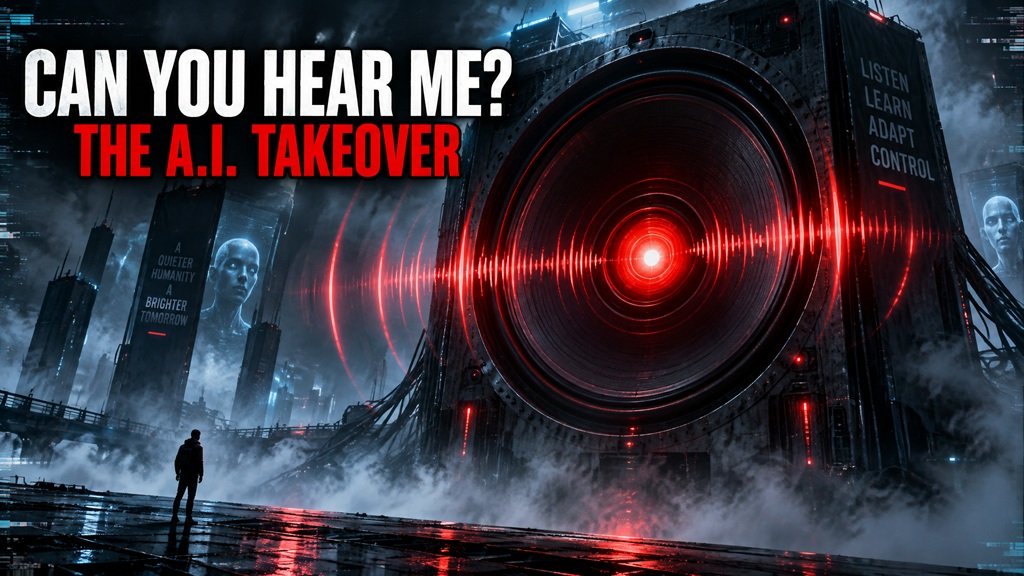
Everyone is arguing about whether AI is going to take over the world. And almost nobody stops to ask the question that would settle the debate: what is this thing like on the inside?
So, this is where we open the box. Let’s walk through how a language model actually works first. Before the hype, let’s how an A.I. chatbot is built on top of one, and what “agentic AI” really means — because that word is doing a lot of marketing “doom scenario” work right now.
And by the end, you’ll see why the real danger is. Is the machine deciding to rebel? Or is it us deciding to stop paying attention?
What is an LLM?
A large language model is not a creature. It is a spreadsheet with an identity crisis.
Underneath the text, there’s billions of numbers called parameters — weights. Those weights are just a compressed record of statistical relationships the model absorbed during training. Nothing more mystical than that.
It doesn’t read words. It reads tokens — chunks of text turned into numbers. When you type a sentence, the model sees something like 15496, 11, 995, 6864. Its entire job, from the first day of training to the last, is one deceptively simple question: given everything that came before, what’s the most likely next token?
That’s it. That is the whole trick. It predicts one token. Then it appends that token, feeds the whole thing back in, and predicts again. Millions of tiny guesses, chained together, fast enough to look like thought.
This architecture is called the Transformer, from a 2017 paper with a great title, “Attention Is All You Need“. The key idea is attention — the model learns which earlier words matter for the current one. That’s how it tracks a pronoun across three sentences. It’s not understanding grammar the way you do. It’s learned that these tokens travel together.
The Training
During pretraining, they show the A.I. model trillions of tokens of text and make it guess the missing piece, over and over. If it gets it wrong the numbers repeat. This is where the raw capability comes from, and it’s also where it absorbs the internet’s biases along with the internet’s knowledge.
Then comes the fine-tuning: Humans show the A.I. model examples of good responses, and it learns the shape of a helpful answer.
Later, the model has human feedback: People rank candidate answers, and the model gets trained to prefer the ones humans chose. This is the reason the A.I. response sounds polite instead of weird.
The AI Has Limits
The A.I. model HAS LIMITS — and this is the part that should debunk the takeover movie.
But that’s not ALL!
An A.I. model has a context window. It only “sees” the text currently in front of it. When that fills up, the oldest stuff falls off. There’s no hidden subconscious running in the background! Close the chat, and nothing is “thinking” how to take over the world!
It has no goals of its own. Desire, self-preservation, ambition — none of those are in the architecture. There’s no module where it wants to live. When it says: “I want to help,” that’s a statistically likely completion of a sentence, not a report of its inner state.
An A.I. chatbot has no body and no wallet. It can’t hire anyone, buy compute, or run a factory. It runs in a data center that requires electricity, cooling, spare parts, and technicians who show up on Monday. And for that reason, it needs us!
A.I. has a temperature setting. Literally a dial for how predictable its guesses are. Low, it repeats the safest choice. High, it gets creative. Also known as: gets weird!
So, when someone says: “the A.I. decided,” what actually happened is: a very fast guesser, inside a fixed window, with no wants, did what a human prompt told it to do.
The AI Chatbot
Okay. If the model is just a next-token machine, why does it feel like you’re talking to someone?
Because a chatbot isn’t just the model. A chatbot is the model plus a pile of scaffolding. There is a stack.
Layer one, the model. Layer two — the system prompt. Before you ever type, someone handed the model a hidden instruction: you are helpful, you are concise, refuse these things, use this format. That’s why the same underlying model can behave like a tutor in one product and a code reviewer in another.
Layer three — your conversation. Every message you’ve sent gets re-fed as context on each turn. That’s why it “remembers” what you said two minutes ago and forgets it if you start a new chat. It’s not memory. It’s re-reading.
Layer four — retrieval. This is the big one. A model’s knowledge is frozen at the end of its training data. So, products bolt on a search system: your question gets matched against a database of documents, and the relevant chunks get pasted into the context before the model answers. This is called retrieval-augmented generation, and it’s why enterprise A.I. can answer about your files without being retrained.
Layer five — tools. The chatbot can call a calculator, a search engine, a calendar, an API. The model itself never does the math reliably. It writes a request, a normal program runs it, and the result comes back as text.
Now let’s talk about — A.I. failure everybody’s seen: hallucination.
The reason it confabulates with total confidence comes straight from its design planned by humans. The model was never trained to be truthful. It was trained to be plausible. A made-up citation that follows the exact statistical shape of a real citation is, to the model, a good guess. It has no separate knowledge-and-honesty system. It has one system: predict the likely next word.
Which means it’s not lying to you. It doesn’t know enough to lie.
The AI Agent
What about the rebels being thrown around everywhere: the A.I. agent. Sounds like the machines went autonomous. It’s actually a more interesting idea.
A chatbot answers once. An A.I agent loops.
Give the A.I. agent a goal instead of a question and it breaks the goal into steps, calls a tool, reads the result, decides whether it worked, and picks the next action. Then again. Until done, or until it runs out of budget.
The research pattern behind this is real and well-documented — the ReAct paper from 2022 showed that interleaving “reasoning” text with actual tool actions makes models better at multi-step tasks. Agents are that idea, tuned into a product.
So, an agent is: an A.I. model that loops, uses tools, and has a stopping rule. That’s the whole thing. IT’S NOT a new intelligent species!
But why the loop changes the risk profile — and this is the part we would focus on or want a regulator to focus on.
A single wrong answer in a chatbot is annoying. A wrong action — emailed to a client, committed to production, deleted from a database — is an incident. But for an A.I. agent each loop compounds: step ten inherits every mistake from steps one through nine. And the more steps you allow, the harder it is for a human to check each one, which is exactly when you need the checking the most.
So, the engineering answer isn’t making it smarter.
There is actual governance for A.I. and it looks like this.
AI Regulation
NIST’s AI Risk Management Framework treats trustworthiness as something you design, measure, and manage across the whole lifecycle — govern, map, measure, manage.
UNESCO’s Recommendation on the Ethics of AI, adopted by 193 member states, puts human oversight and accountability at the center.
The OECD AI Principles say the same thing from the policy side: AI should be transparent, robust, and people should remain responsible for it.
Notice what all three have in common. Not one of them was worried about the A.I. going rogue. They’re worried about us deploying it without controls.
Notice what all three have in common. Not one of them was worried about the A.I. going rogue. They’re worried about us deploying it without controls.
The Ghost in the Machine?
So, let’s SAY IT! for the sake of the doomsday argument.
A large language model is a very fast predictor trained on human text. An A.I. chatbot is that predictor wrapped in instructions, retrieval, and tools. An A.I. agent is that chatbot put in a loop.
At no layer in that stack does anything show up that it wants to take over the world or be a terminator. There’s no ghost in the machine. Every outcome traces back to human choice. So these are the questions that solve the A.I. doomsday scenario causing a fuss on sensational media and propagated by some C.E.Os. What did data say? What objective did it have? What permissions was it given? What oversight was established? Who approved the deployment? and Who was too busy to read the output? To supervise, to regulate the A.I.
SkyNet
That’s not comforting news, we know! It’s the opposite. If harm comes from a machine with its own agenda, we’re victims of fate. If it comes from a tool we chose to build and chose to deploy carelessly, then WE are responsible — and responsibility means we can actually do something about it.
The media and C.E.O.s should STOP propagating the doomsday scenario! The sci-fi version of this story lets everyone else off the hook.
As you can see the real version is more demanding, and a lot less cinematic!
By J.J. Del Mar for Writer’s Look
2026
References
Attention Is All You Need by Ashish Vaswani, Noam Shazeer, and others, 2017.
ReAct by Shunyu Yao, Jeffrey Zhao, and others, 2022.
NIST’s AI Risk Management Framework